Crypto wallet testing software focuses on validating security (key management, phishing resistance, transaction integrity) and performance (speed, multi-chain reliability, resource usage) because wallets handle irreversible private keys and assets. Failures can lead to total fund loss, unlike traditional apps.
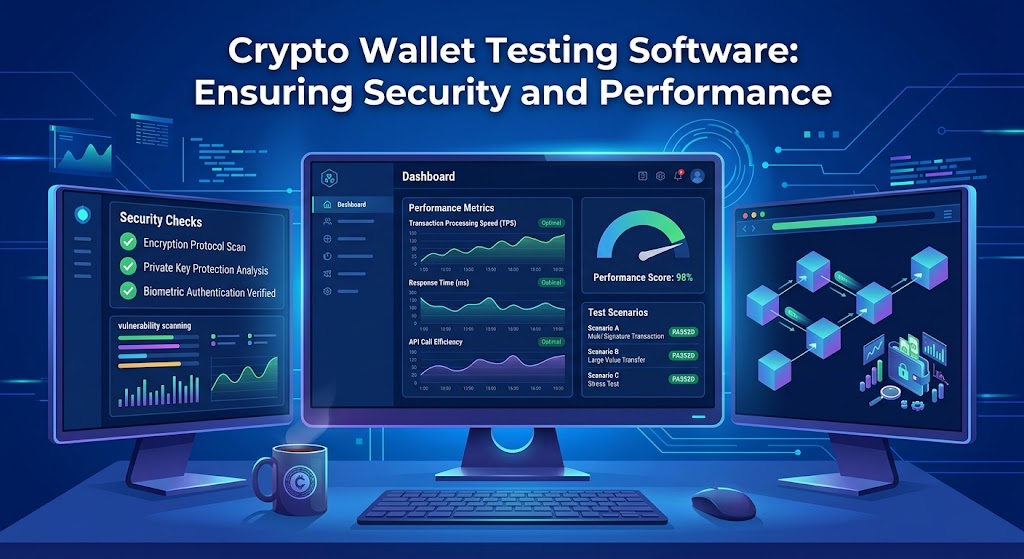 Key Areas for Security Testing
Crypto wallets introduce unique attack surfaces not present in standard software:
Private key / seed phrase handling: Entropy quality of generation, secure storage (never in plain text or logs), memory clearing after use, and backup/recovery flows.
Transaction signing and display: Accurate parsing and user-visible details so users don’t approve malicious or incorrect transactions. Include simulation of outcomes (tokens out/in, gas).
matching, ENS resolution, and protection against sending funds to wrong/invalid addresses.
Physical and device security (especially mobile/hardware): Resistance to screenshots of sensitive data, tamper evidence, side-channel risks.
Other vectors: Frontend injection, RPC endpoint exposure, transaction malleability, and compromised node scenarios.
security). Includes a testing dApp that simulates attack scenarios for consistency.
WalletProbe / WalleTruth: Academic mutation-based testing frameworks using visual-level oracles. Applied to dozens of browser extensions; they uncovered numerous attack vectors allowing asset theft (many later patched).
WalletRadar: Automated static + dynamic analysis tool that detected vulnerabilities across many browser wallets.
General tools: Burp Suite (proxy/intercept for dynamic analysis and injection testing), MobSF (mobile static/dynamic analysis), OWASP ZAP, Ganache or local testnets for safe simulation, Hardhat/Foundry for related smart-contract/fuzz testing, and custom scripts for entropy/RNG validation (e.g., NIST SP 800-22 tests)
Professional services (BetterQA, DeviQA, Coinspect, CertiK, etc.) often combine gray-box penetration testing, phishing simulations, and checklists covering seed generation/storage, node trust, 2FA/PIN, and platform-specific issues (mobile screenshot prevention, extension permissions
Best practices: Never use real keys or mainnet funds. Prefer testnets (Sepolia, etc.), mainnet forks (Tenderly/Alchemy), or local chains. Integrate SAST/SCA into CI/CD. Conduct continuous rather than one-off testing. Hardware/cold wallets require additional physical interaction simulation (button presses, OCR for screens) because full automation is harder
Performance Testing Focus
Wallets must remain responsive under real blockchain conditions:
Transaction speed, gas estimation accuracy, and fee handling across networks with different block times (Ethereum ~12s, Solana ~400ms, L2s sub-second).
Balance sync accuracy and recovery after network interruptions, RPC failures, or congestion
Cold-start time, memory/CPU usage on low-end devices, and multi-chain support (12+ chains common).
Stress under high load, latency injection, and reorgs/bridge delays
Useful tools and approaches:
Mobile/UI automation: Appium, Espresso, XCUITest for cross-device flows.
API testing: Postman or REST Assured for balance/fee/transaction endpoints independent of UI.
Load/stress: JMeter, Gatling, k6, Locust.
Chaos engineering: Inject latency, failures, or malformed responses.
Blockchain-specific: Hardhat/Foundry for local testing and gas reporting; testnet faucets and mainnet forks for realistic conditions without cost
Recommended Overall Approach
Start with checklists from Coinspect, CertiK, or similar for systematic coverage.
Combine automated frameworks (WalletProbe-style or static analyzers) with manual/gray-box pen testing.
Use isolated environments (testnets, forks, sandboxes) exclusively.
Cover both hot (software/extension/mobile) and cold/hardware wallets, noting the latter often need more manual or custom hardware automation.
Measure and report on both security (vulnerability counts, exploit resistance) and performance (latency, success rates under stress, resource metrics).
For production wallets, pursue independent audits and maintain continuous monitoring/alerting.
Open-source resources like the Coinspect framework and academic tools provide a strong starting point for developers and auditors. Professional QA/security firms specialize in end-to-end wallet testing because of the high stakes and multi-chain complexity. Always prioritize key isolation and user-intent clarity, as these remain the most common failure points.
Recommended - Download Flash USDT Software Latest Version