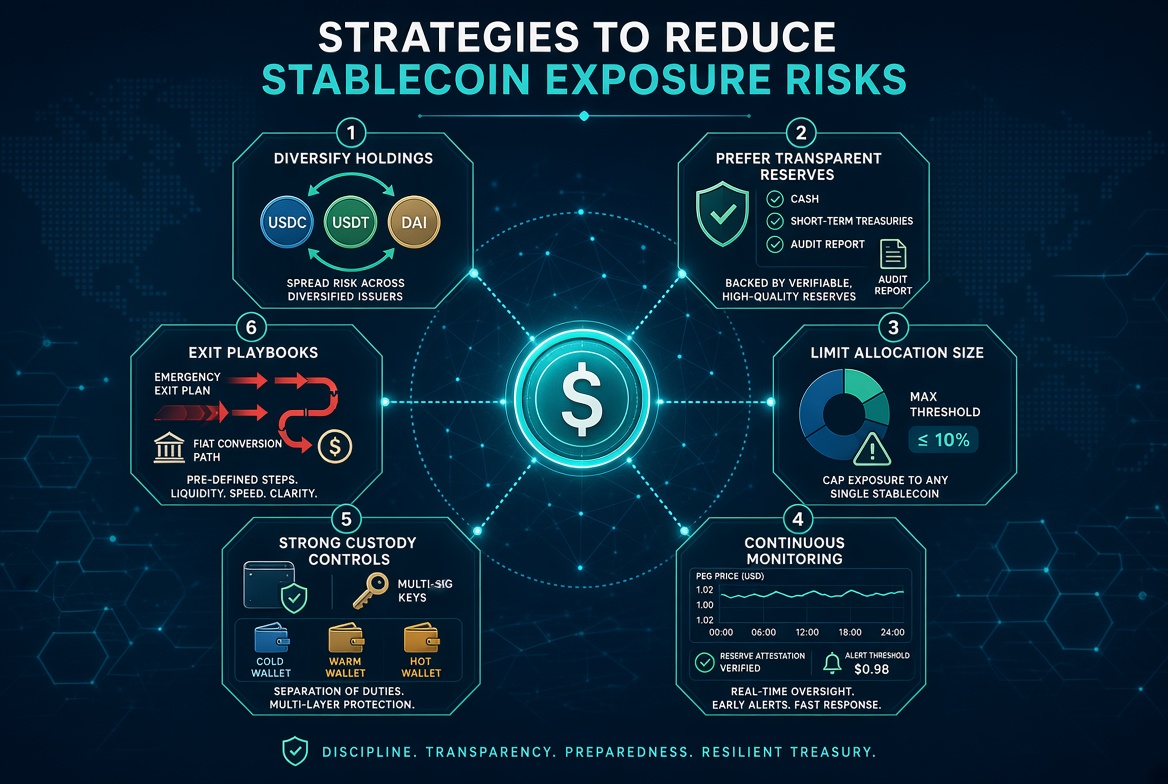
Diversify holdings, prefer high-quality transparent reserves, limit allocation size, monitor closely, use strong custody, and maintain clear exit plans. These are the primary practical strategies for reducing stablecoin risks (depegging, issuer/counterparty failure, reserve quality issues, regulatory actions, smart-contract failures, and liquidity/redemption frictions)
 1. Diversify Across Issuers and Designs
Spread exposure across multiple major stablecoins rather than concentrating in one (e.g., a mix of USDC + USDT + a decentralized option like DAI/USDS).
This reduces single-issuer or single-reserve failure risk. A common practical split for larger holdings is roughly 60/40 between two major fiat-backed coins on the same chain, or broader mixes that include different backing models.
Avoid putting 100% of any buffer or operational cash into one stablecoin. Cap single-stablecoin exposure (e.g., at 25% of the relevant portfolio or treasury allocation in some frameworks
2. Prefer High-Quality, Transparent, Well-Regulated Coins
Favor stablecoins backed primarily by cash, short-term U.S. Treasuries, or equivalent high-quality liquid assets, with frequent independent attestations (monthly preferred).
USDC is frequently cited for stronger transparency (monthly Deloitte attestations), regulatory alignment (including post-GENIUS Act frameworks and MiCA in relevant jurisdictions), and institutional reserve management.
USDT offers superior liquidity and exchange support but historically has less frequent/detailed transparency.
DAI (and similar over-collateralized designs) provides on-chain verifiability
and no direct address-freeze capability at the token level, but introduces smart-contract, collateral-volatility, and liquidation risks (and can inherit exposure to other stablecoins via mechanisms like the Peg Stability Module).
Avoid pure algorithmic designs or those with opaque/unclear collateral. Over-collateralized crypto-backed models can help but are not immune to stress
3. Limit Size and Set Exposure Thresholds
Treat stablecoins as a cash-management or liquidity tool, not a high-conviction long-term holding. Keep only what is needed for operations, trading, or near-term needs.
Establish hard allocation bands and automatic conversion triggers back to fiat (or other low-risk assets) when exposure exceeds limits or when market signals appear.
Maintain a fiat or high-quality money-market buffer so you are never fully reliant on stablecoin redemptions during stress.
4. Monitor Reserves, Peg, and On-Chain Data Continuously
Track issuer reserve attestations, composition, and any changes in custody or duration risk.
Set price alerts (e.g., at $0.98 and $0.95) for early depeg warnings.
Watch secondary-market liquidity, redemption volumes, and on-chain metrics. Use tools that provide real-time visibility into issuance, redemptions, and counterparty exposure where available.
Review regulatory developments (e.g., GENIUS Act requirements in the U.S. for 1:1 high-quality reserves, monthly disclosures, and timely redemption)
5. Strengthen Custody and Operational Controls
Prefer self-custody (hardware wallets or multi-sig setups) for longer-term holdings to reduce exchange/custodian risk; keep only operational amounts on centralized platforms.
For larger or institutional use: implement wallet tiering (cold/core treasury vs. warm rebalancing vs. limited hot wallets), multi-sig governance, allowlists, and policy controls.
Ensure robust key management, reconciliation processes that handle on-chain data, and clear segregation of reserves where applicable.
For cross-chain use, treat bridged/wrapped versions as higher risk; favor native issuance and controlled hub-and-spoke treasury designs with explicit rebalancing rules.
6. Prepare Explicit Exit and Stress Playbooks
Define in advance what triggers conversion to fiat or other assets (peg deviation, issuer news, regulatory action, liquidity drying up).
Test processes in limited pilots before scaling.
Understand redemption mechanics and any friction (timing, minimums, banking partners).
Be aware that even high-quality reserves can face temporary market bottlenecks or banking-system disruptions (as seen in historical events like the 2023 SVB-related USDC depeg).
Additional Considerations
Yield caution: Higher yields often come with extra risks (lending, derivatives hedging, etc.). Question anything significantly above comparable low-risk rates.
Regulatory and jurisdictional factors: Align with the strictest relevant rules (U.S. GENIUS Act-era standards, EU MiCA, etc.). Compliance, AML/KYC, and sanctions screening matter for larger users.
No risk-free option: All stablecoins carry residual risks. Diversification and size limits mitigate but do not eliminate correlated stress (multiple coins can wobble together in a broad crisis).
Businesses/treasuries should also educate teams, integrate into existing cash processes, and maintain operational backstops separate from pure reserve assets.
These strategies draw from institutional guidance, risk frameworks, and observed market behavior. The optimal mix depends on your size, time horizon, jurisdiction, and whether the stablecoins are used for trading, payments, DeFi, or treasury. Always verify current reserve reports and regulatory status directly from issuers, as the landscape evolves.