While stablecoins like USDT and USDC are designed to maintain a stable 1:1 value with the US dollar, they carry structural and operational risks distinct from holding traditional fiat currency in a FDIC-insured bank account.
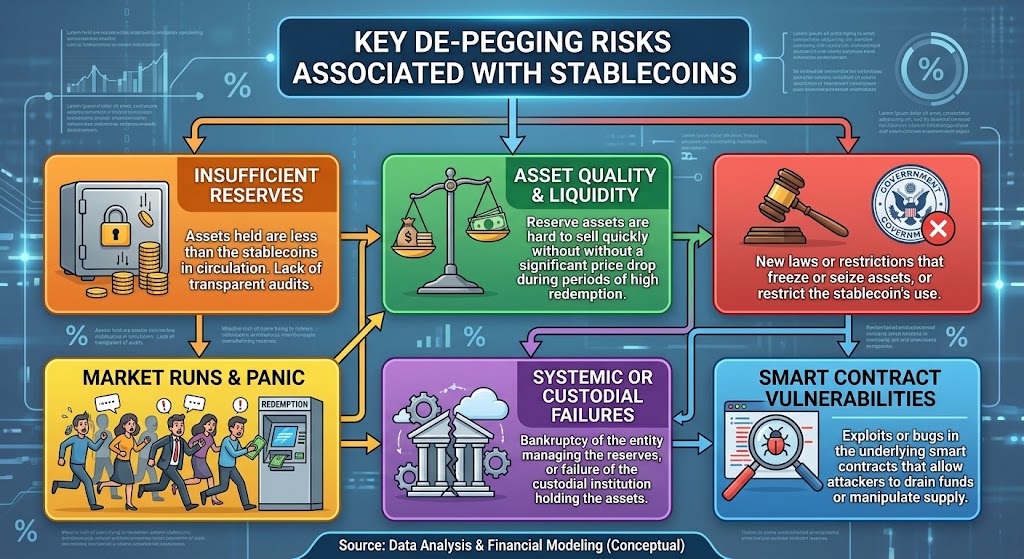 These risks generally fall into three main categories: smart contract risk, counterparty/issuer risk, and de-pegging risk.
1. Smart Contract & Technical Risks
Smart contract risks stem from the underlying code running on blockchain networks that issues, transfers, or locks stablecoins.
Code Vulnerability and Exploits: Reentrancy bugs, logic errors, or unhandled edge cases in a stablecoin's smart contract can allow malicious actors to mint unauthorized tokens or drain locked collateral.
Composability Risk in DeFi: When stablecoins are deposited into decentralized lending protocols, yield aggregators, or liquidity pools (e.g., Curve or Uniswap), a vulnerability in that secondary protocol can result in lost or frozen assets, even if the native stablecoin contract itself is secure.
Upgradability & Admin Key Risk: Many stablecoin contracts contain administrative functions (e.g., pause, upgrade, or emergency burn) controlled by multi-signature wallets or central authorities. If an administrative private key is compromised, an attacker could manipulate token functionality or freeze funds.
Cross-Chain / Bridge Vulnerabilities: Native multi-chain stablecoins or wrapped versions (e.g., bridged USDC on alternative networks) rely on cross-chain bridges. Bridges represent major attack vectors; if a bridge is exploited, the wrapped tokens on the destination chain can lose their underlying collateral and become worthless.
2. Counterparty & Issuer Risks
Counterparty risk concerns the centralized entities responsible for managing the off-chain reserves, issuing the tokens, and executing redemptions.
Reserve Composition & Illiquidity: Centralized issuers hold reserves backing their tokens. If these reserves include illiquid assets (commercial paper, corporate debt, or real estate loans) rather than cash and short-term Treasuries, the issuer may face liquidity shortages during run-on-the-bank redemption scenarios.
Custodial & Banking Partner Exposure: Issuers rely on traditional financial institutions to hold fiat reserves. If an issuer’s custodian bank fails or faces solvency issues (as seen during the 2023 Silicon Valley Bank collapse), access to the backing collateral can be delayed or impaired.
Regulatory & Sanctions Enforcement: Issuers like Tether and Circle maintain central freeze capabilities. Under court orders, law enforcement requests, or global sanctions regimes, issuers can blacklist specific blockchain addresses, permanently freezing the stablecoin balance within those wallets.
Lack of Formal Deposit Insurance: Unlike traditional bank deposits, stablecoin holdings do not benefit from FDIC or equivalent government-backed deposit insurance. In the event of issuer insolvency, token holders rank as unsecured creditors.
3. De-Pegging Risks
De-pegging occurs when market forces or structural mechanics cause the market price of a stablecoin to diverge from its $1.00 target on secondary exchanges.
Liquidity Crises & "Bank Runs": If market participants lose confidence in an issuer's solvency, rapid sell-offs on secondary markets can drain liquid DEX pools and centralized exchange order books faster than the issuer can process off-chain fiat redemptions, leading to a temporary or permanent discount.
Algorithmic Collateral Failure: Non-fiat algorithmic stablecoins rely on game-theoretic arbitrage mechanics, dual-token structures, or crypto-collateral ratios (e.g., Terra/UST, DAI). Under extreme market volatility, cascading liquidations or run-away minting mechanisms can cause systemic collapse and total de-pegging.
Market Microstructure & Order Book Contagion: Large whale liquidations or forced sell-offs across major lending platforms can trigger automated cascading liquidations, momentarily causing stablecoin values to slip below peg on individual exchanges.
Regulatory Interventions: Unanticipated regulatory action, such as an injunction, asset freeze, or ban on a specific issuer, can severely restrict secondary market liquidity and prompt widespread de-pegging.
Recommended - Flash USDT Software Guide, Installation & Instructions