

Posted by Macron Will
23 Jul, 2026
Understanding the Differences Between USDT Tether and USDC Coin
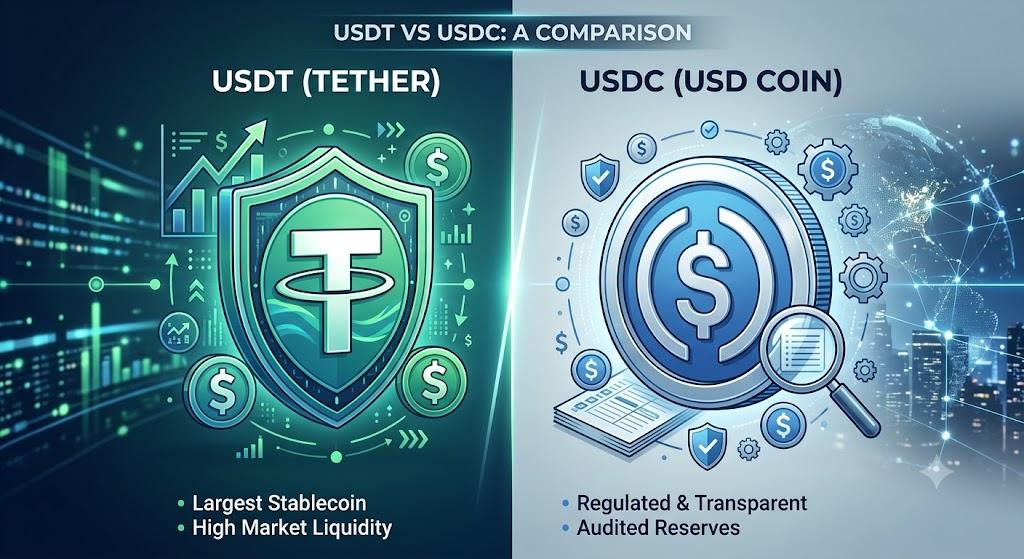
USDT (Tether) and USDC (USD Coin) performs similar actions serving the same purpose in the Cryptocurrency World. However, USDT is the Senior of USD pertaining to the history of the two largest stablecoin.
USDT (Tether) and USDC (USD Coin) are the two largest fiat-backed stablecoins, both designed to maintain a 1:1 peg to the US dollar. They serve as key infrastructure in crypto for trading, payments, remittances, DeFi, and treasury management
Market Position (as of mid-2026)
USDT: Dominant leader with ~$184 billion in circulation (around 59% of the total stablecoin market). It has unmatched liquidity and trading volume.
USDC: Second place with ~$73–74 billion in circulation. It has grown in institutional and regulated use cases but trails significantly in overall market share and daily volumes.
USDT benefits from first-mover advantage (launched 2014) and broad availability, while USDC (launched 2018) positions itself as the more compliant, transparent alternative.
Issuers and Regulation
USDT: Issued by Tether Limited (affiliated with Bitfinex). Headquartered in El Salvador (previously British Virgin Islands). It operates with less direct US regulatory oversight and has faced historical scrutiny, fines, and investigations (e.g., from the NY AG) over past reserve claims and transparency. It is strengthening compliance, including US-regulated versions like USA₮.
USDC: Issued by Circle Internet Financial (in partnership with Coinbase via the former Centre Consortium). US-based with strong regulatory licenses (e.g., NY, New Hampshire money transmitter licenses). It aligns closely with US regulations, MiCA in the EU, and institutional standards. Circle files with the SEC and emphasizes compliance
Key takeaway: USDC is generally viewed as lower regulatory and compliance risk, especially for institutions and businesses in regulated jurisdictions. USDT excels in less-regulated or emerging markets.
Reserves and Transparency
Both claim 1:1 backing and over-collateralization with surpluses, but their approaches differ:
USDC:
Backed by highly liquid assets: cash (at major banks), short-term US Treasuries, and overnight reverse repos.
Managed partly via the Circle Reserve Fund (USDXX), an SEC-registered money market fund by BlackRock.
High transparency: Weekly disclosures, monthly attestations by Big Four firm (Deloitte), detailed breakdowns, and public SEC filings. Reserves consistently match or exceed circulation
USDT:
Mix of US Treasuries (majority), cash/cash equivalents, secured loans, Bitcoin, gold, and other investments.
Improved but still debated transparency: Quarterly attestations (e.g., by BDO), daily circulation reports, and recent moves toward a full Big Four audit. Reserves show surpluses (e.g., billions over liabilities), with heavy Treasury allocation. Past issues included commercial paper exposure (now eliminated) and less granular real-time detail
Key takeaway: USDC offers superior, more frequent, and verifiable transparency. USDT has made significant progress and holds substantial reserves, but its diversified (and sometimes less liquid) assets plus offshore structure lead to ongoing skepticism from some observers
Liquidity, Adoption, and Use Cases
USDT: Superior liquidity, deeper order books, and more trading pairs on centralized exchanges (CEXs). Dominant on Tron (low fees) and widely used in emerging markets, DeFi, and high-volume trading. Preferred for arbitrage, speculation, and global accessibility
USDC: Strong in regulated ecosystems, institutional integrations (e.g., Visa, Mastercard, BlackRock), payments, treasury, and on-chain apps on Ethereum, Base, Solana. Better for businesses needing audit trails and compliance.
Both are redeemable 1:1 (with conditions), multi-chain, and highly liquid overall, but USDT wins on raw volume and breadth.
Risks and Stability
Depegging history: USDC experienced a brief depeg during the 2023 SVB crisis (quickly resolved). USDT has faced multiple depeg episodes historically but maintained the peg through stress.
Counterparty/Issuer Risk: USDC benefits from US regulation and conservative reserves. USDT carries more perceived credit and operational risk due to its history and asset mix, though it has demonstrated resilience.
Censorship/Blocking: USDC (regulated issuer) may face more freezing/blacklisting risks in compliance scenarios. USDT is harder to censor in some contexts.
Both have proven stable in normal conditions, with reserves designed for redemptions.
Which Should You Use?
Choose USDT for maximum liquidity, trading, emerging markets, low-fee chains (e.g., Tron), and broad exchange support.
Choose USDC for regulatory compliance, institutional needs, transparency, payments, or US/EU-focused operations.
Many users and institutions hold both for diversification.
Both are far more stable than volatile cryptocurrencies, but neither is risk-free—always verify current reserves on official sites (tether.to/transparency and circle.com/transparency), use reputable platforms, and consider your jurisdiction's rules. Data evolves quickly; check live sources like DefiLlama for the latest market stats.
Understanding the Differences Between US...