USDT (Tether) and USDC (USD Coin) performs similar actions serving the same purpose in the Cryptocurrency World. However, USDT is the Senior of USD pertaining to the history of the two largest stablecoin.
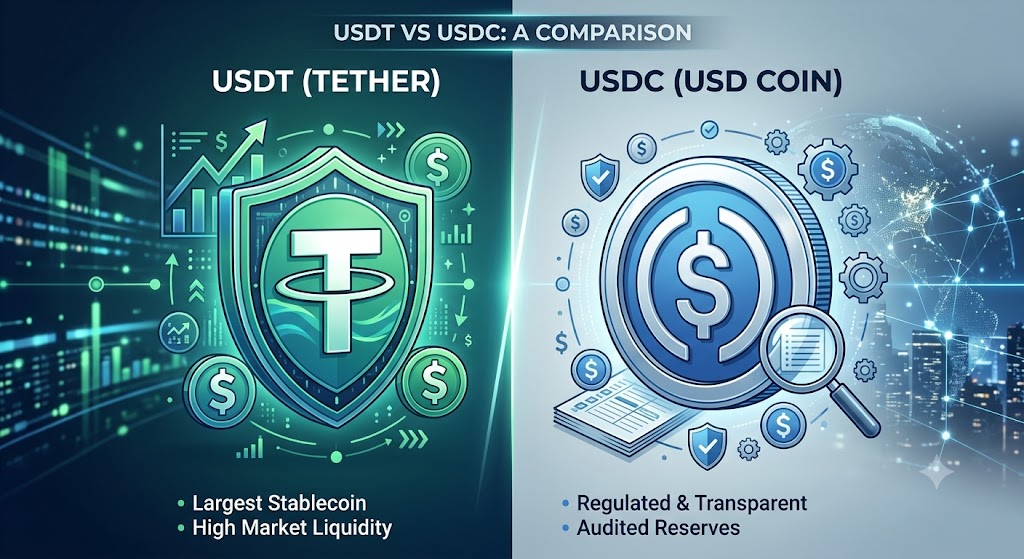 Both USDT (Tether) and USDC (USD Coin) are fiat-collateralized stablecoins pegged 1:1 to the US dollar. While they serve similar functions—allowing users to store value, trade, and transfer funds without direct exposure to crypto volatility—their issuers, reserve structures, regulatory frameworks, and primary use cases differ significantly.
What is USDT
Key facts
Issuer: Tether Limited (part of the iFinex group, which also operates the Bitfinex exchange).
Peg: 1 USDT ≈ 1 USD. It aims to avoid the high volatility of cryptocurrencies like Bitcoin or Ethereum.
Backing: Tether claims each USDT is backed by reserves of equivalent value. These primarily consist of U.S. Treasury bills and other cash equivalents, with smaller portions in secured loans, precious metals, Bitcoin, and other assets. Tether publishes regular attestations (not full audits) of its reserves.
Market position: It is the largest stablecoin by market capitalization (around $184 billion as of recent 2026 data) and ranks among the top cryptocurrencies overall by market cap
What is USDC
USDC (USD Coin) is a stablecoin—a type of cryptocurrency designed to maintain a stable value of approximately $1 per token by being pegged 1:1 to the U.S. dollar.
It is issued by Circle, a regulated U.S. financial technology company. It launched in September 2018 (originally through a joint venture called Centre with Coinbase; Circle now has full governance
Key features
Fully backed reserves: Every USDC in circulation is backed by an equivalent amount of cash and cash-equivalent assets (primarily cash held at regulated financial institutions and short-duration U.S. Treasury securities, often managed via the Circle Reserve Fund by BlackRock). Circle publishes monthly attestation reports from independent auditors (such as a Big Four firm) to verify that reserves match or exceed the outstanding supply.
Redeemable 1:1 for USD: Qualified users can convert USDC to U.S. dollars (and vice versa) through Circle or authorized partners.
Multi-chain: It runs natively on many major blockchains (including Ethereum, Solana, Avalanche, Polygon, Base, Arbitrum, Optimism, and others). Circle’s Cross-Chain Transfer Protocol (CCTP) allows native transfers between supported chains without relying on traditional bridges
Uses: Fast, low-cost global payments and transfers (often near-instant and far cheaper than traditional banking), trading pairs on crypto exchanges, decentralized finance (DeFi) applications, remittances, and as a stable store of value amid crypto market volatility. It is available on numerous exchanges and wallets worldwide.
Key Operational Differences
Liquidity vs. Transparency
USDT holds the first-mover advantage and retains dominant liquidity on centralized exchanges globally. It is often the preferred base pair for crypto trading and rapid global transfers.
USDC prioritizes verifiable reserve composition and regulatory alignment. Each USDC token is backed by cash and short-term U.S. Treasuries, making it popular among institutional players and compliance-focused platforms
Blockchain Network Availability
USDT operates across numerous blockchains, with particularly high adoption on TRON (TRC-20), Ethereum (ERC-20), Solana, and Avalanche
USDC is natively issued across multi-chain ecosystems including Ethereum, Solana, Avalanche, Base, and Arbitrum. (Note: Circle officially discontinued native support for USDC on the TRON network in 2024
Risk Profile & Compliance
Both issuers maintain blacklisting and address-freezing mechanisms on-chain to comply with legal requests or law enforcement orders.
USDC provides stronger institutional safeguards due to explicit adherence to U.S. state and federal financial oversight
USDT offers broader global accessibility and deep market penetration, particularly in emerging markets where non-US liquidity pairs are widely utilized.
Choosing Between the Two
Choose USDT if: You require maximal exchange liquidity, trade heavily on international centralized exchanges, or perform frequent transfers where TRC-20 or alternative low-cost networks are standard.
Choose USDC if: You prioritize strict regulatory compliance, detailed third-party audit reports, or operate within US-based and institutional DeFi frameworks